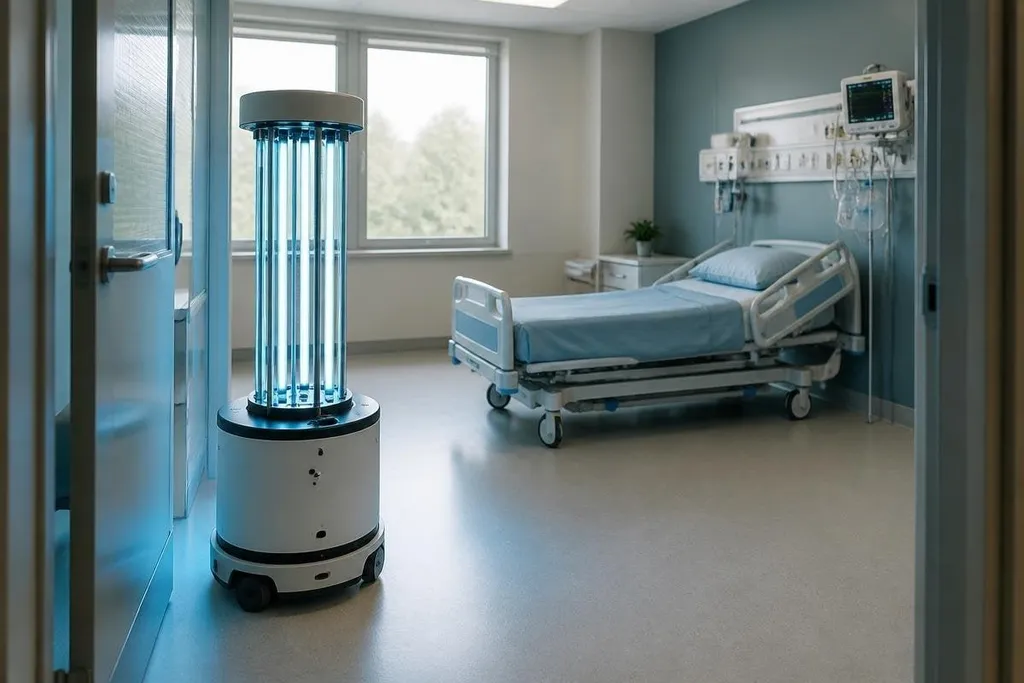
A hospital robot can disinfect an empty room, carry supplies, or let a clinician check on a patient without entering. Those jobs may reduce some paths for healthcare-associated infections, but only when staff use the robot at the right time and check its work.
- Cleaning robots can apply UV-C light or cleaning fluid to exposed surfaces.
- Delivery robots can move meals, medicine, and waste without sending staff through every ward.
- Telepresence robots can support remote checks when a physical visit is not needed.
The jobs robots can handle
Infection control depends on many small actions. A surface must be cleaned, a used item must leave the room, and staff must avoid carrying germs from one patient area to another. Robots can take on parts of that routine, especially in spaces with clear routes and repeatable tasks.
An autonomous mobile robot uses sensors, maps, and software to move without a person steering it at every turn. In a hospital, it might carry sealed supplies between a storage room and a ward, then return for another trip. That does not remove the need for staff, but it can cut some unnecessary movement through patient areas.
A disinfection robot works in a different way. Some models use UV-C light, while others spray or wipe a cleaning chemical.
UV-C can damage germs on surfaces, but the light must reach the surface directly. A bed rail behind equipment or a shaded section of a room may receive little or no treatment.
That limit matters more than the robot's travel speed. A machine can finish its programmed route and still leave areas that need manual cleaning.
Why timing matters
A disinfection robot usually works after people and equipment leave the room. Staff must first remove waste, clean visible dirt, and place equipment where the robot can reach it. The robot then runs its cycle, records the task, and waits until the room is cleared for entry.
This creates a handoff between people and software. If the door is opened too soon, the cycle is interrupted. If the room layout changes, the robot's map may no longer match the space. If staff treat a completed software log as proof that every surface is clean, the system can create false confidence.
Delivery robots face a different problem. Their value depends on the route, the handoff, and the items they carry. A sealed tray can move through a corridor with little contact, while an open container or poorly cleaned robot handle can add a new contact point.
Hospitals should measure the full process, not count robot trips. Useful measures include missed cleaning areas, room turnaround time, manual entries avoided, and faults that require staff to step in.
A Robot24.com report on hospital robots can place those measures beside the machine, cleaning task, test site, and recorded result. That record leads into the limits that follow.
What robots cannot solve
Robots don't replace hand hygiene, isolation procedures, or careful cleaning. They also don't fix a crowded ward, poor storage, or unclear responsibility for a room between patients.
The open question is whether a robot changes infection rates in a specific hospital, rather than only completing a task more neatly. That answer needs local records, repeat measurements, and a clear comparison with the old process. A vendor's route log can show where the robot went. It cannot, by itself, show that infections fell.
I'd treat a hospital robot as a process tool, not as an infection-control system on its own. The purchase makes sense when the hospital can name the task, set a pass standard, and check the result without adding work for nurses or cleaners.
A practical buying check
Use these questions before approving a pilot:
- Name the task: Which room, route, or handoff will the robot handle?
- Set the pass mark: What result counts as a completed cleaning or delivery?
- Map the exceptions: What happens when a person, bed, trolley, or spill blocks the route?
- Keep manual checks: Who confirms shaded surfaces, chemical use, and room release?
- Review the records: Can staff see failed runs, delays, battery faults, and interrupted cycles?
Start with one ward and one repeatable task. Compare the robot process with the current process for missed areas, staff time, room access, and infection-control records. If the robot adds checks without removing work, the hospital has bought another task rather than a useful tool.
The next test is plain: run the robot beside the existing process, record every exception, and keep it only if the full workflow leaves fewer infection risks than before.